
RUNWAY: How Lady Gaga and Doechii Made the Most Important Fashion Film of 2026
There is a moment, roughly forty seconds into the music video for “RUNWAY,” when Lady Gaga pours tea from a teapot while wearing a dress that looks exactly like the teapot she is pouring from. The lyric, timed precisely to the gesture, is: “You gon’ burn your tongue on this tea.” It is funny, it is absurd, it is impeccably styled and it tells you everything you need to know about what Gaga and Doechii have made together. This is not a promotional asset. This is not a tie-in single dressed up in borrowed couture. “RUNWAY,” released April 27th and directed by Parris Goebel, is a fully realised work of fashion filmmaking; one that happens to have a chorus built for arenas and a chart position to match.
The song is the lead single from the The Devil Wears Prada 2 soundtrack, out May 1st, in which Meryl Streep returns as Miranda Priestly and finds herself navigating the decline of print media against the machinations of Emily Blunt’s now-formidable former assistant. Gaga also makes a cameo appearance in the film itself , and the track plays during a behind-the-scenes sequence set during Milan Fashion Week, which means the music video is less a standalone artifact than a prologue, a fashion world unto itself that opens onto the larger world of the film. The fictional Runway magazine appears in-video as a physical object: Gaga and Doechii are seen reading a copy featuring Emily Charlton on the cover, a wink sharp enough to cut glass.
The Sound: House, Hip-Hop, and the Harlem Ballrooms
Before the clothes, there is the beat. “RUNWAY” is a house and hip-hop song with influences of ballroom, whose lyrics explore themes of self-affirmation, ambition, and confidence, using the runway as a metaphor for exposure and success. It opens with a borrowed line; a brief excerpt from the 1996 film The Nutty Professor, in which Eddie Murphy’s Sherman Klump states: “No matter what, no matter what… you’ve got to strut.” The choice is not casual. Sherman Klump is a character defined by his complicated relationship with his own body and his place in the world. To open a fashion anthem with his voice is to make an argument: that strutting is not vanity, but survival.
Produced by Andrew Watt, Bruno Mars, Cirkut and D’Mile, the track’s production has been described as a mixture of house and hip-hop, inspired by ballroom culture. NME noted that it is built around an ‘80s-inspired electronic beat, while Slant Magazine wrote that Gaga’s hook nods to the largely anonymous soul singers who appeared on the house-pop songs that dominated radio airwaves in the early ’90s. Jenesaispop.
Gaga delivers a spoken first verse, in a style reminiscent of “Babylon” from her 2020 album Chromatica, before joining Doechii on the chorus, while Doechii takes on the majority of the song’s vocal sections. Her verse “Yes, serve a little sass / Yes, with a little side of ass / Yes, got the front row screaming”. It echoes precisely where it lives: in the slippage between the catwalk and the dance floor, in the tradition of ball culture performance that stretches back through Harlem’s underground ballrooms, through Paris Is Burning, through Madonna’s “Vogue,” and into the mainstream with a confidence those originators were rarely afforded. It just manifests some of the greatest artists mixed together.
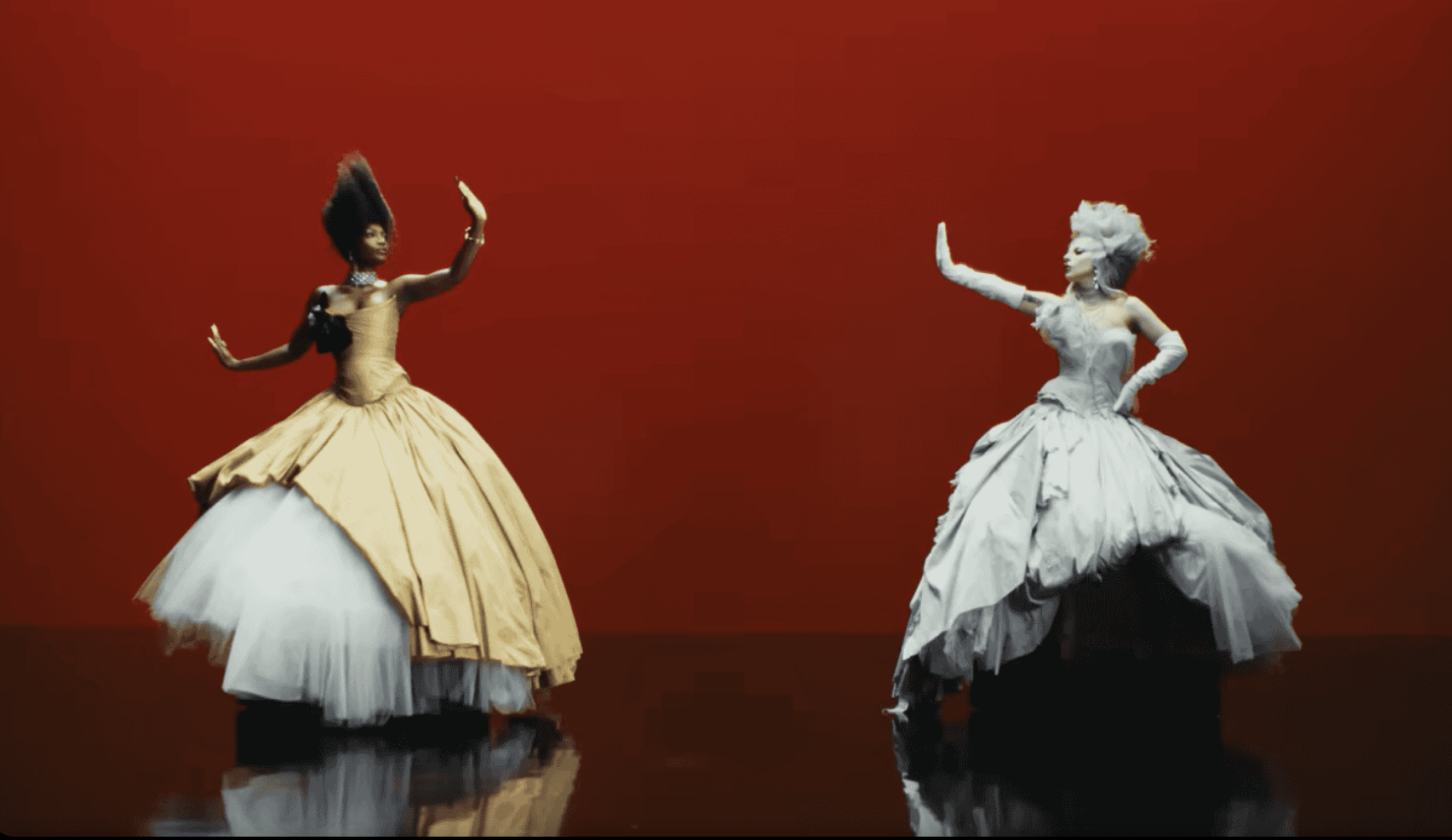
Custom gowns by New York-based couturier Miss Claire Sullivan
The Video: A Fashion Week Schedule, Not a Film
Directed by Parris Goebel, the music video showcases designs from both emerging and established fashion houses, with choreography by Goebel alongside Robbie Blue. Goebel previously directed Gaga’s “Abracadabra” and brings a shared visual grammar: large-scale group formations, ballroom-inspired movement, theatrical staging. But where that video used a single warehouse to devastating effect, “RUNWAY” fragments its world into a series of self-contained chambers each set its own micro-universe, its own backdrop, its own internal logic. The effect is closer to a fashion week schedule than to conventional video filmmaking. You are not watching a narrative unfold. You are attending a season.
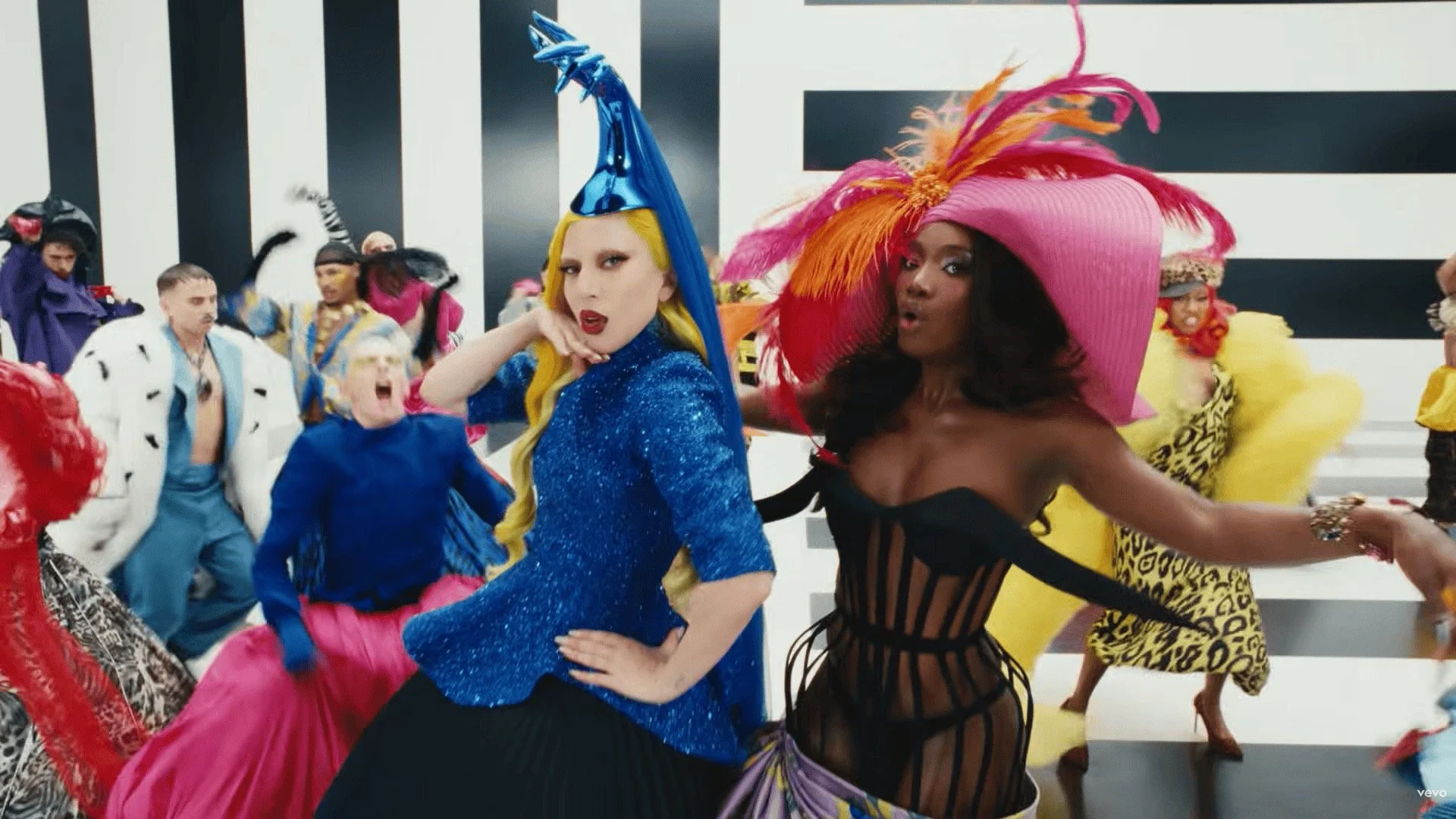
The video opens on a black and white striped studio; immediately compared by viewers to the aesthetic of Beetlejuice, filled with dancers dressed like high fashion whirling dervishes and club kids. The black-and-white setting finds Gaga in a pleated blue gown and a colour-coordinated veil with an outstretched hand as its crown surrealist millinery functioning as emotional armour. She is also, from the very first frame, sporting the yellow waves most closely associated with the “Telephone” video from 2010. InStyle and Attitude both noted that the yellow hair recalls her hairstyle from “Telephone,” drawing a visual connection to her earlier work; a self-citation so deliberate it reads less as nostalgia than as authorship. I made that, the hair says. I am still making things.
Doechii answers in a black cage dress with a swath of lavender floral fabric wrapped just below the hips, crowned with a truly fabulous fuchsia hat with a burst of colourful feathers. Drama as counterpoint. Structure yielding to exuberance. The two women, from their very first frames, establish themselves as visual equals: not matching, but rhyming.
The Wardrobe: Fourteen Looks, Zero Compromises
The styling credits include Chloe and Chenelle Delgadillo as fashion editors alongside Kyle Luu and Sam Woolf ; a team whose combined sensibility threads the needle between avant-garde and wearable, between conceptual statement and genuine desire. This is not a video dressed. It is a video curated.
The designers assembled read like a manifesto for where fashion is going rather than where it has been. They include Viktor & Rolf, Gaurav Gupta, Harris Reed, and Robert Wun , alongside LUAR, Daniel del Valle, Miss Claire Sullivan, Bad Binch Tong Tong and Thom Solo. The selection maps neatly onto the current conversation in fashion: sculptural, gender-fluid, technically ambitious, culturally specific. These are not celebrity dressing choices. They are arguments.
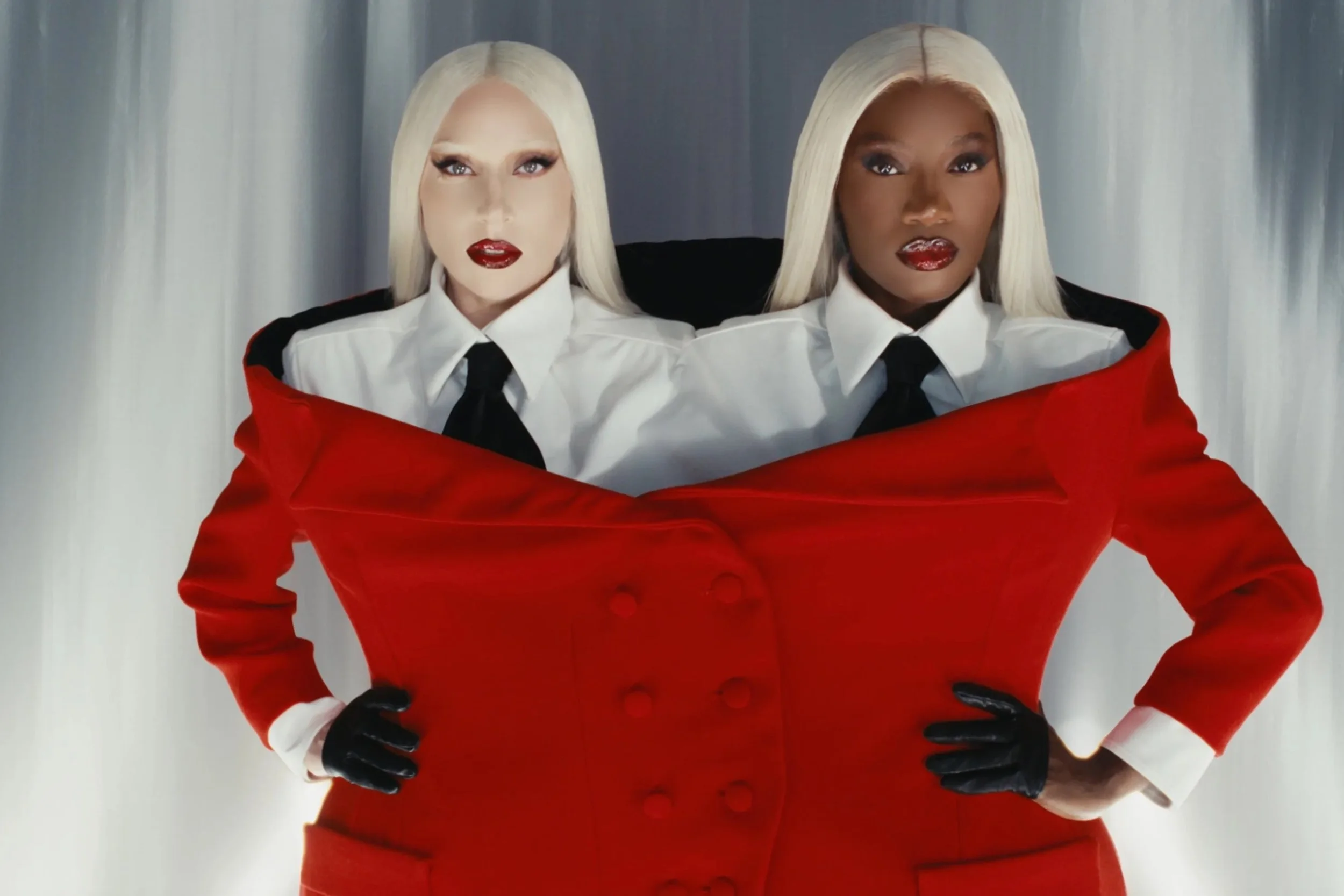
The video’s most conceptually rich single garment is the custom red suit built for two people, worn simultaneously ; a piece by LUAR that physically literalises the collaboration at the video’s heart. Two distinct aesthetics, two distinct bodies, one garment. Couture as concept. Alongside it, the pair appear in matching platinum wigs , the twinning gesture pushed to its logical extreme.
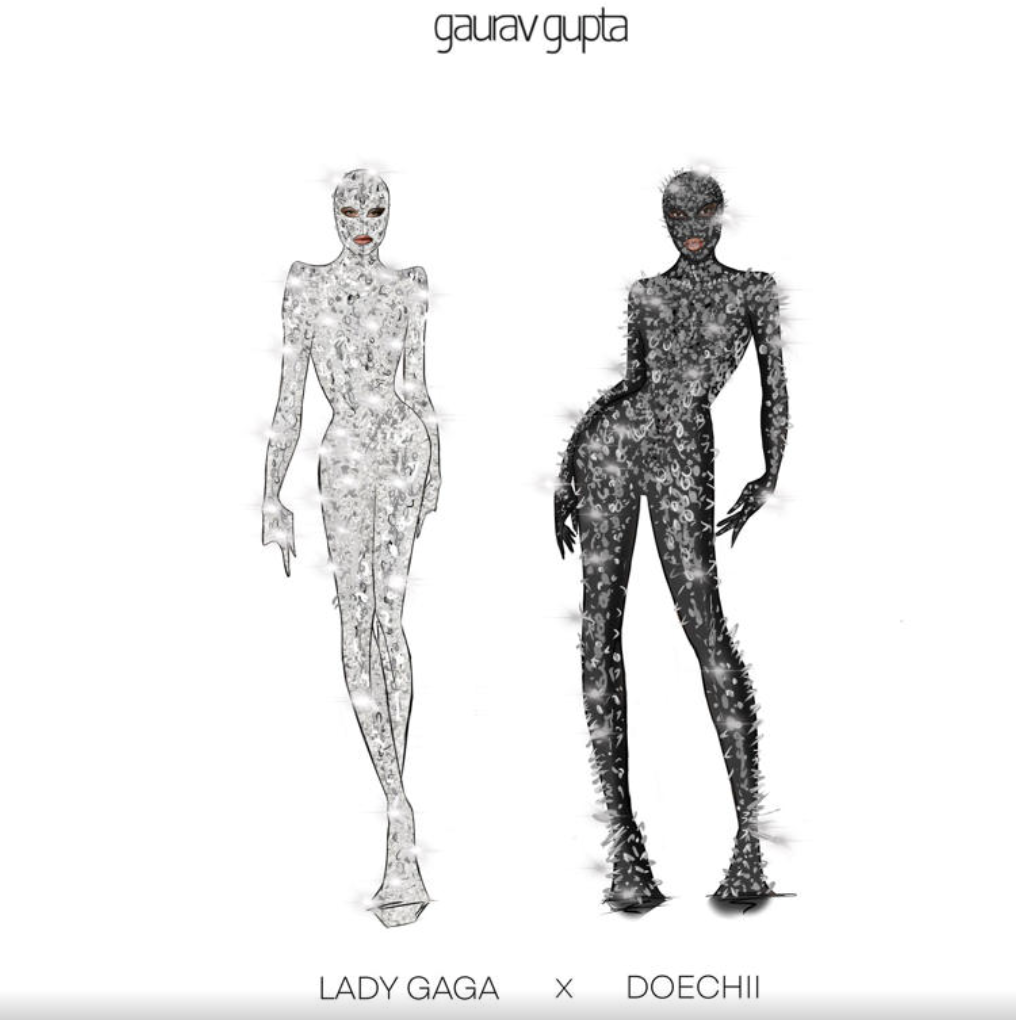
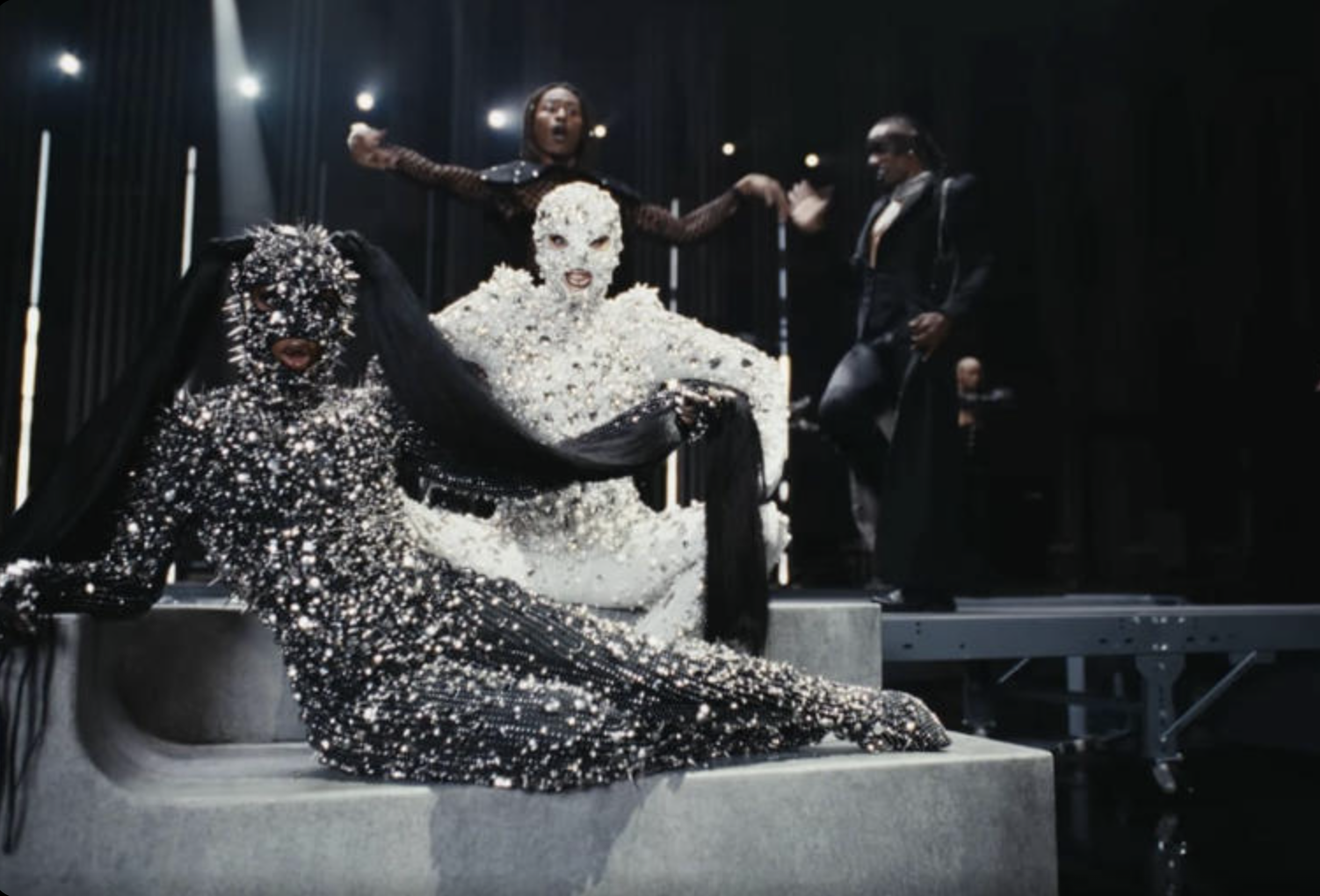
Then come the custom Gaurav Gupta Couture bodysuits covered in crystals and spikes; worn as near-identical twins, one in black and one in white . The Indian couturier whose architectural draped forms have redefined red carpet language across the past five years here operates in a different register: totemic, otherworldly, operatic. Only eyes and mouths are visible. The rest is sculpture.
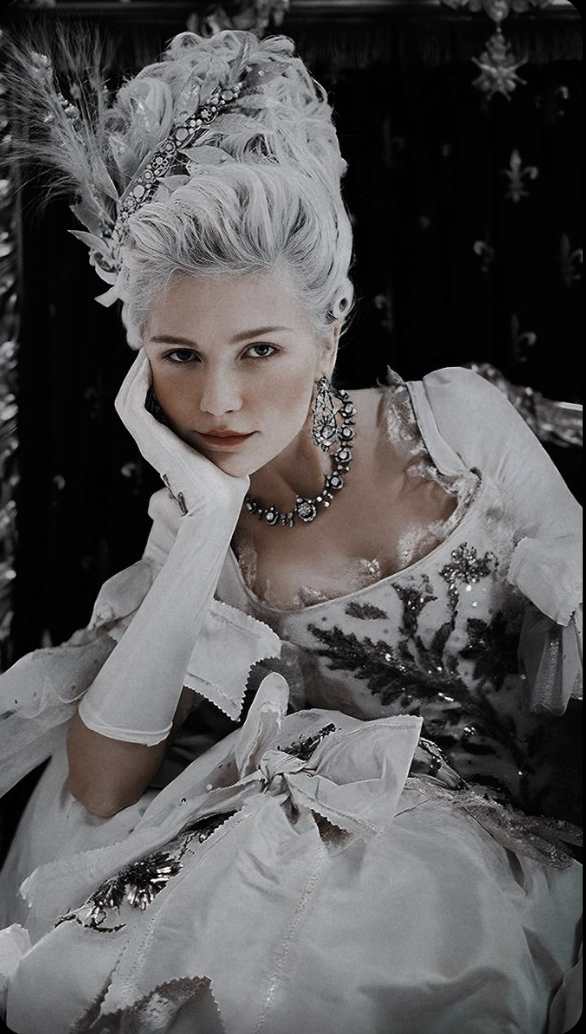
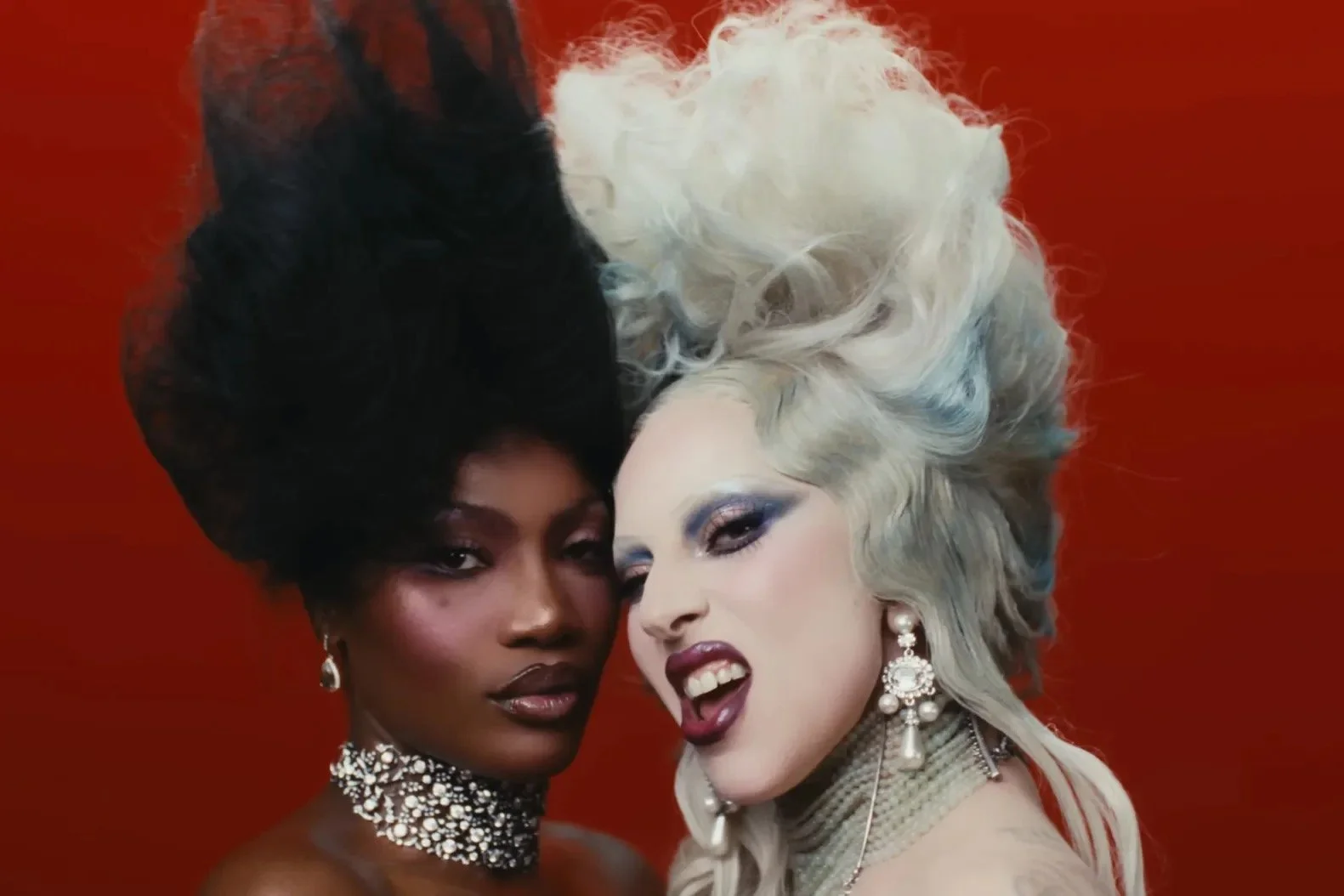
On a blood-red stage, the duo becomes a pair of modern-day Marie Antoinettes in custom gowns by New York couturier Miss Claire Sullivan:Gaga in silver, Doechii in gold. Victorian excess filtered through ballroom fantasy, the choreography continuing beneath the volume of the skirts, refusing to be contained. Later, Gaga appears in the viral urn dress from Daniel del Valle’s breakout Fall 2026 London Fashion Week show a ceramic-effect gown placed in a scene timed to the tea-pouring lyric. Costume design as punchline. High fashion as theatre prop. Del Valle is twenty-six years old. By the end of the week his name was everywhere.
Gaga’s solo tour de force comes in a custom red patent leather catsuit described as “Catwoman meets M. Bison from Street Fighter” worn with red crocodile opera platform heels, both by Thom Solo. The pitchfork heel from the film’s promotional artwork appears in the same frame: film mythology colliding with fashion mythology, both reaching for the same iconographic register.
The video closes where it began, the black and white striped studio; but with allegiances swapped: Doechii now in white, Gaga in black. A visual palindrome. Fashion eating itself, beautifully, in under three minutes.
The Beauty: Faces Built for Movement
Hair was overseen by Frederic Aspiras, Gaga’s long-standing collaborator, with makeup led by Eden Lattanzio. Together they uphold the tradition established across Gaga’s visual history: that beauty, in her universe, is never naturalistic. It is always conceptual. Always in service of an idea larger than the individual face.
Aspiras works in the tradition of hair-as-sculpture. The yellow waves are a deliberate archive moment; the platinum wigs of the two-person suit sequence push twinning into the uncanny. Across each set change, the hair shifts register as completely as the clothing; not as accessory to the look but as equal participant in it. Lattanzio’s makeup direction is theatrical rather than photographic: faces conceived for movement, for distance, for impact at the speed of a camera cut. Graphic lids. Doe-like liner. Skin that catches light like lacquered paper. In the Gaurav Gupta bodysuit sequence, where only eyes and mouths remain visible, Lattanzio’s work is left to carry the scene’s entire emotional register; which it does, completely, without hesitation.
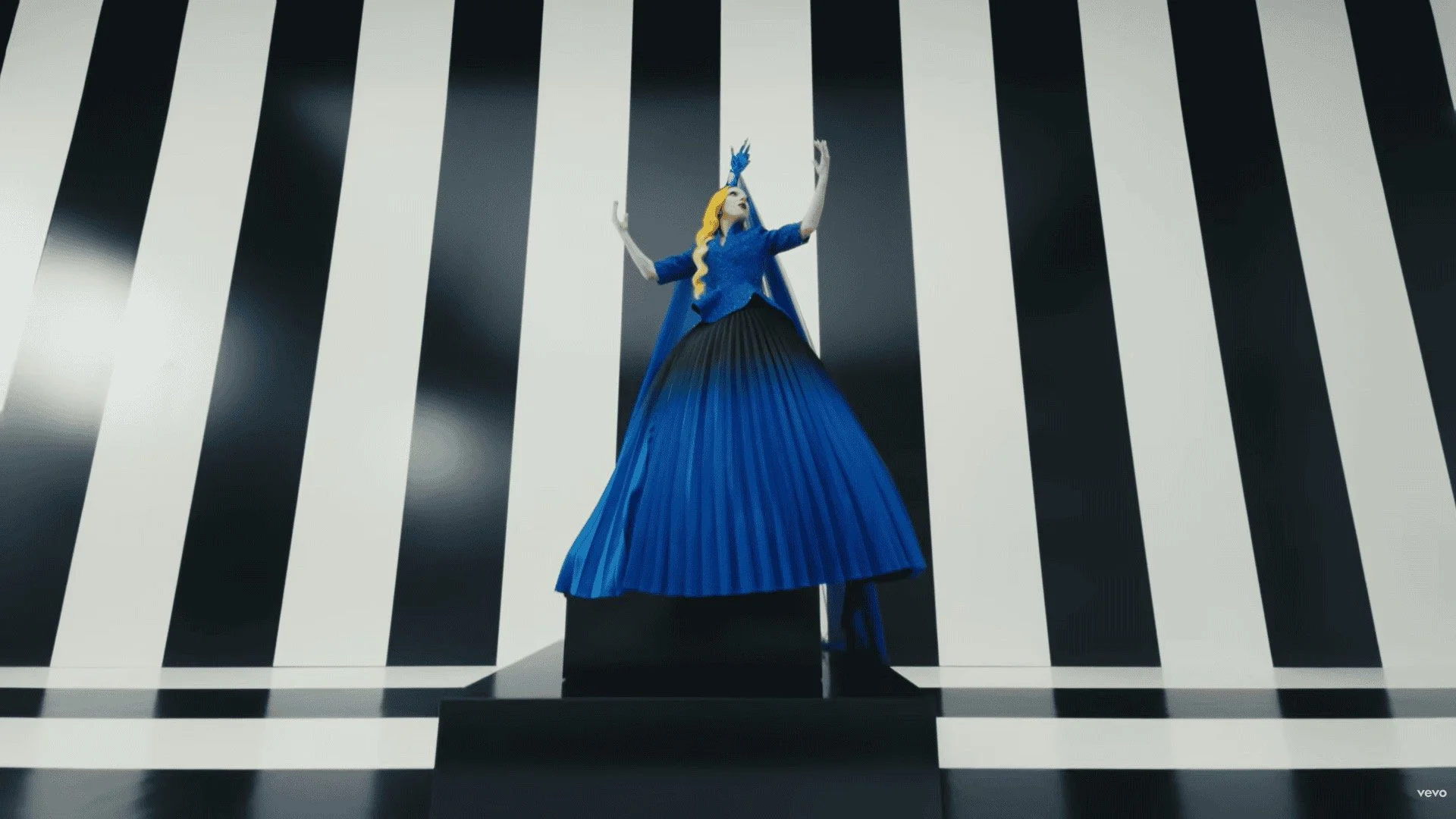
Sporting the yellow hair waves again wearing Robert Wu Couture Spring/Summer 2026
The Collaboration: Mutual Admiration as Creative Force
The partnership between Gaga and Doechii did not emerge from a label brief. It grew from genuine mutual recognition and respect. Doechii presented Gaga with the Innovator Award at the 2025 iHeartRadio Music Awards. Gaga returned the compliment in British Vogue, saying Doechii came “out of the gate with a pen that feels immediately legendary,” and added that she had “fallen in love with her music and her raw, deeply personal perspective.” Doechii, for her part, described audibly gasping upon hearing the praise saying “For a legend like that to say that about me, it really, really validated me in a humbling way.”
Their chemistry, visible in every frame of the video, confirms what close watchers of new talent had already acknowledged: Doechii is not a feature. She is a co-equal. In “RUNWAY” she brings not just rap credibility or chart appeal but a fully formed aesthetic sensibility, the Swamp Princess visual language that has made her one of the most referenced artists in fashion in 2026 that keeps pace with, and in several moments surpasses, Gaga’s own flamboyance. These are two performers who raise each other’s ceiling simply by occupying the same frame.
At the film’s New York premiere on April 21st, Gaga described Doechii as a “brilliant artist” and confirmed they had been working on additional material together. Doechii had previously hinted as much to E! News, describing the experience as “amazing” and suggesting they “have more to come.” “RUNWAY” is not a one-off. It is the opening movement of something larger.
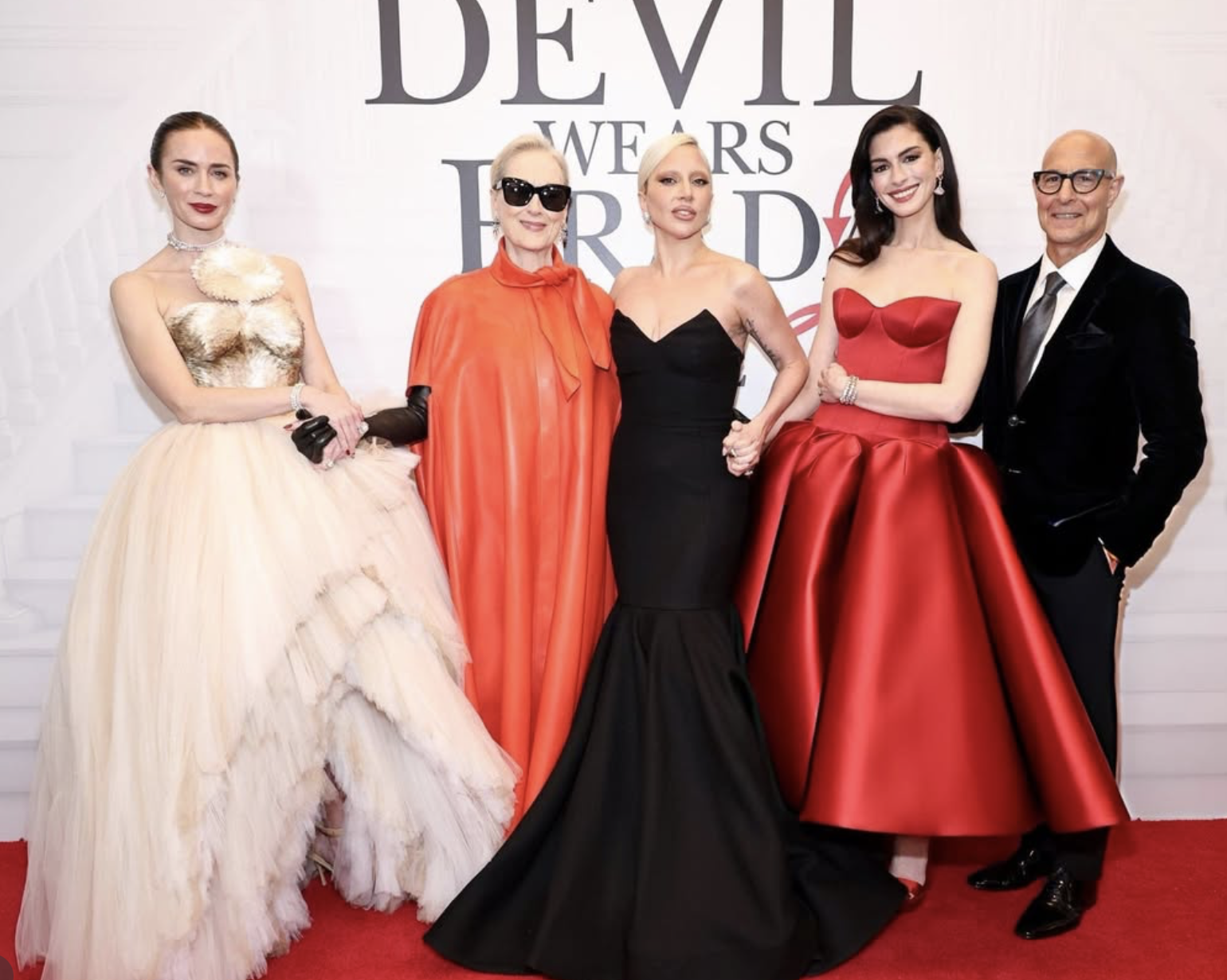
Lady Gaga with the ‘Devil Wears Prada 2’ cast at New York Premiere
Why It Matters: The New Fashion Film
What “RUNWAY” ultimately represents beyond the looks, beyond the chart positions, beyond the film it serves, is a recalibration of what music videos can achieve when fashion is treated as a primary language rather than a secondary aesthetic. Harper’s Bazaar described the video as an example of “high camp” that reinforces the centrality of fashion within the visual , while Billboard highlighted the variety of avant-garde looks and runway-inspired visuals that Gaga and Doechii present. Pitchfork called it simply “extravagant.” All three are correct. None of them are complete.
The more precise description is this: “RUNWAY” is a fashion film with a hit record attached. The designers featured Gaurav Gupta, Harris Reed, Daniel del Valle, LUAR, Robert Wun are not merely dressing celebrities. They are being platformed, their ideas given three minutes of global visibility at the precise moment the industry needs new names at the front of the conversation. This is fashion patronage in its most modern form: not a paid placement, not a gifted look on a red carpet, but a genuine creative collaboration in which the garment is as much a protagonist as the performer wearing it.
The runway, in Gaga and Doechii’s hands, is a metaphor that holds more weight than the film it soundtracks. It is a space for visibility. A declaration that you will not disappear quietly.Something that Lady Gaga has always encouraged and celebrated openly. A place where fashion, music, individuality, ballroom history, couture ambition and pop instinct are married; not as a brand exercise, but as something that feels, against all odds, like a genuine act of faith.
No matter what, you’ve got to strut.
“RUNWAY” by Lady Gaga and Doechii is available now on all streaming platforms. The Devil Wears Prada 2 releases in cinemas May 1, 2026.
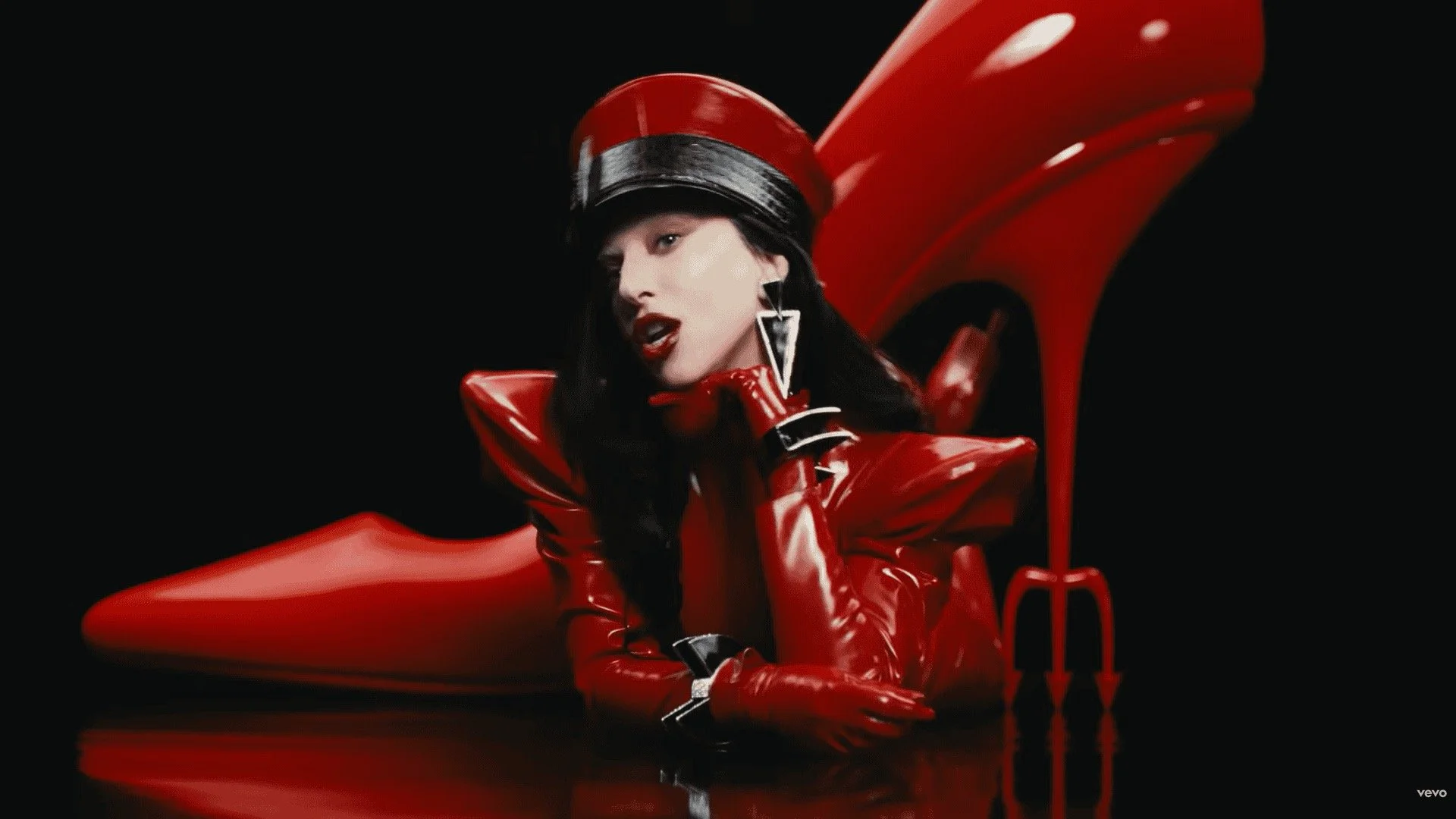
Custom Box red latex catsuit