
Frida Kahlo London Exhibition 2026: The Making of an Icon at Tate Modern
Opens on June 25 at Tate Modern London, Frida: The Making of an Icon arrives not simply as an exhibition, but as the cultural event of the summer a pilgrimage for anyone who has ever felt the magnetic pull of Frida Kahlo’s gaze. Before the doors even open, the show has already entered the museum’s history books: more than 41,000 tickets sold in advance, making it Tate Modern’s highest pre‑selling exhibition of all time. London, in the heat of June, is bracing for a new wave of Frida Fever.
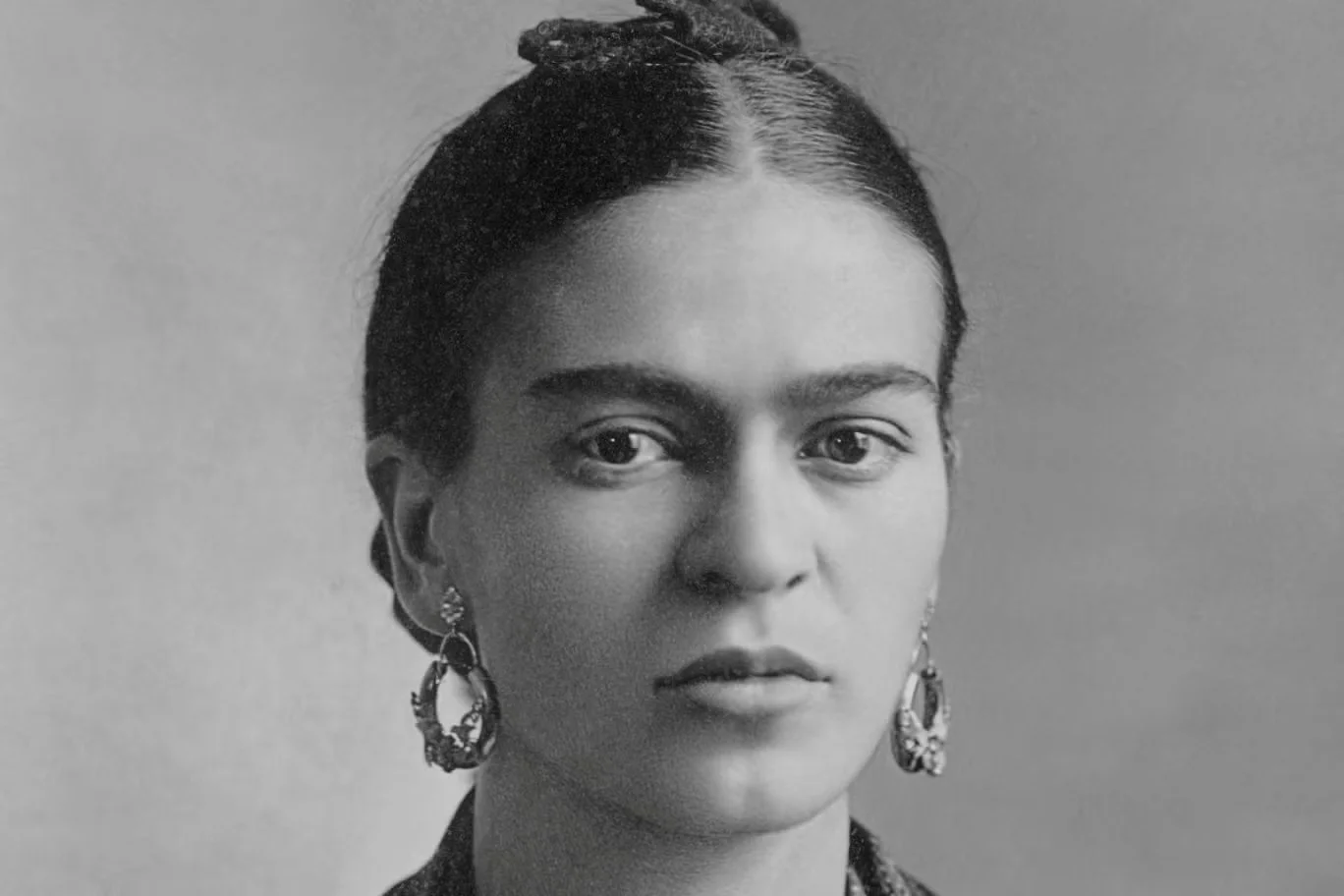
Frida Khalo by Guillermo Khalo
What makes this moment remarkable is not the scale of the exhibition, but its paradox. In a world saturated with Frida’s image printed on T‑shirts, candles, tote bags, and cake toppers the Tate’s show offers something far rarer: scarcity. Only 33 original Kahlo works appear in the exhibition, fewer than originally promised and dramatically fewer than the 80 pieces shown in Tate’s 2005 retrospective. And yet, this scarcity has become the show’s greatest allure. The few paintings present burn with an intensity that pulls the entire exhibition into orbit.
The Many Selves of Frida
Rather than a traditional retrospective, the exhibition unfolds as a study of identity or rather, identities. Kahlo’s “many selves” appear through her paintings, garments, letters, and the objects she curated around her life. The devoted wife. The intellectual. The modernist. The political activist. The woman who turned pain into visual language. Each of the 33 works becomes a chapter in a story that is both deeply personal and universally resonant.
Surrounding these rare pieces are over 200 works by her contemporaries and by artists who have reinterpreted her across generations — from Ana Mendieta’s visceral feminist interventions to Tracey Emin’s confessional intensity. Together, they form a constellation of influence, showing how Kahlo’s presence has rippled through art, fashion, and culture for nearly a century.
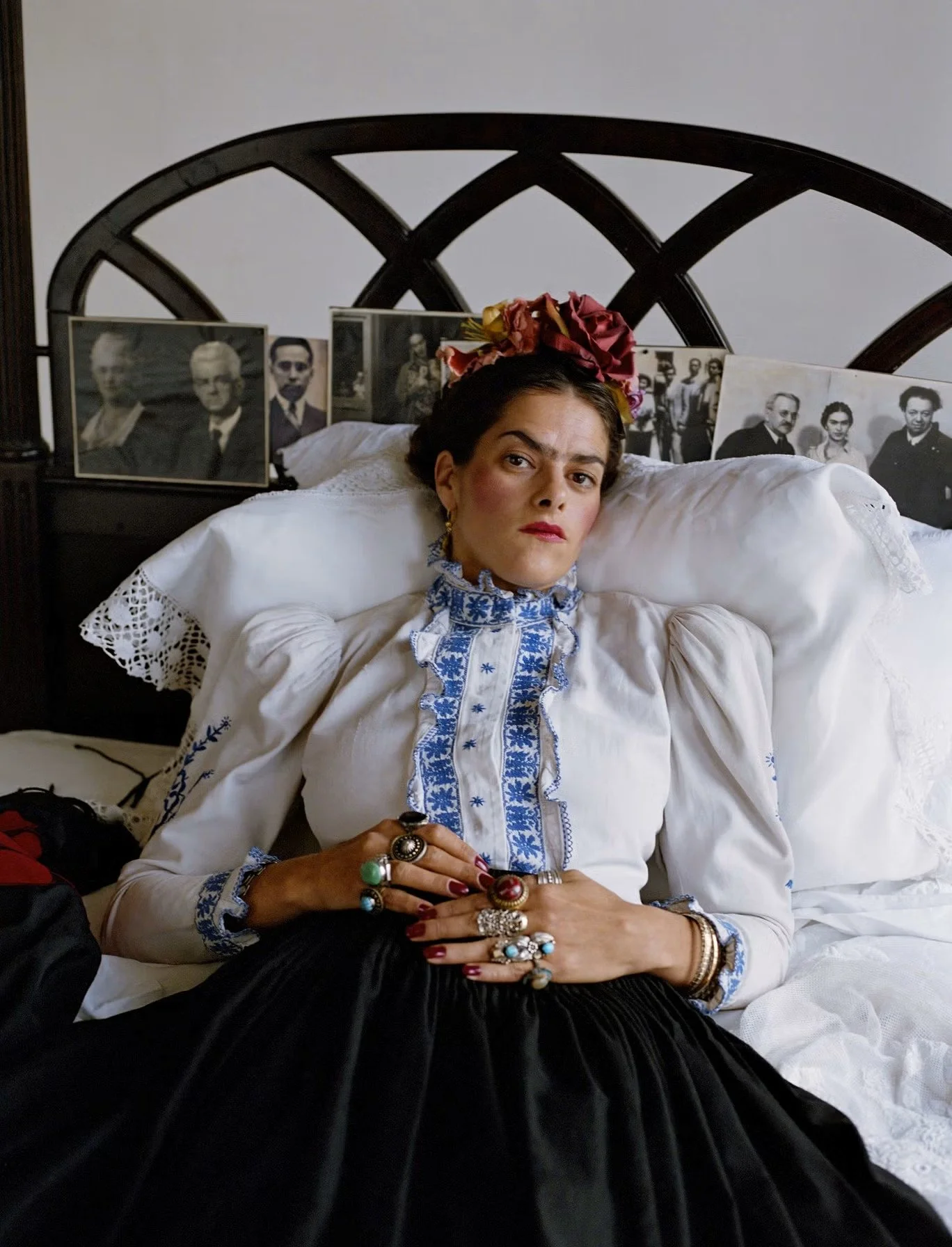
Mary McCartney’s Being Frida, featuring Tracey Emin, stands out as one of the most compelling reinterpretations within Tate Modern’s Frida: The Making of an Icon. Part of the 200 works by artists inspired by Kahlo, McCartney’s portrait captures the tension between myth and woman, icon and individual. Emin’s presence adds a raw, contemporary dialogue, bridging two generations of uncompromising female voices. Together, they illuminate the enduring power of Frida’s image endlessly reimagined, never diminished.
The Power of Frida Style
Kahlo’s style the Tehuana dresses, the braided crowns, the flowers, the jewellery has become as iconic as her paintings. But the exhibition makes clear that her aesthetic was never decorative. It was political, cultural, and profoundly intentional. Clothing became her armour, her identity, her rebellion. It was a way of asserting control over her image in a world that often sought to define her through illness, marriage, or tragedy.
In the galleries, her garments sit beside her paintings like mirrors. The embroidery echoes the brushstrokes; the silhouettes echo the compositions. Her style becomes a language one that continues to inspire designers, artists, and entire communities who see in her a symbol of resilience, creativity, and unapologetic self‑invention.
Scarcity as Magnetism
The irony is striking: an exhibition with fewer Kahlo works than expected has become the most sought‑after in Tate Modern’s history. But this scarcity is precisely what heightens the experience. Kahlo’s paintings are now among the most valuable and difficult to loan in the world her 1940 self‑portrait El sueño (La cama) sold for $54.7 million, making her the most expensive woman artist at auction. Securing loans has become a near‑impossible task.
And yet, the public’s desire to see her even in fragments has only intensified. The rarity of her works amplifies their aura. Each painting becomes a rare encounter, a moment of intimacy with an artist whose life has been mythologised, commodified, and endlessly reproduced.
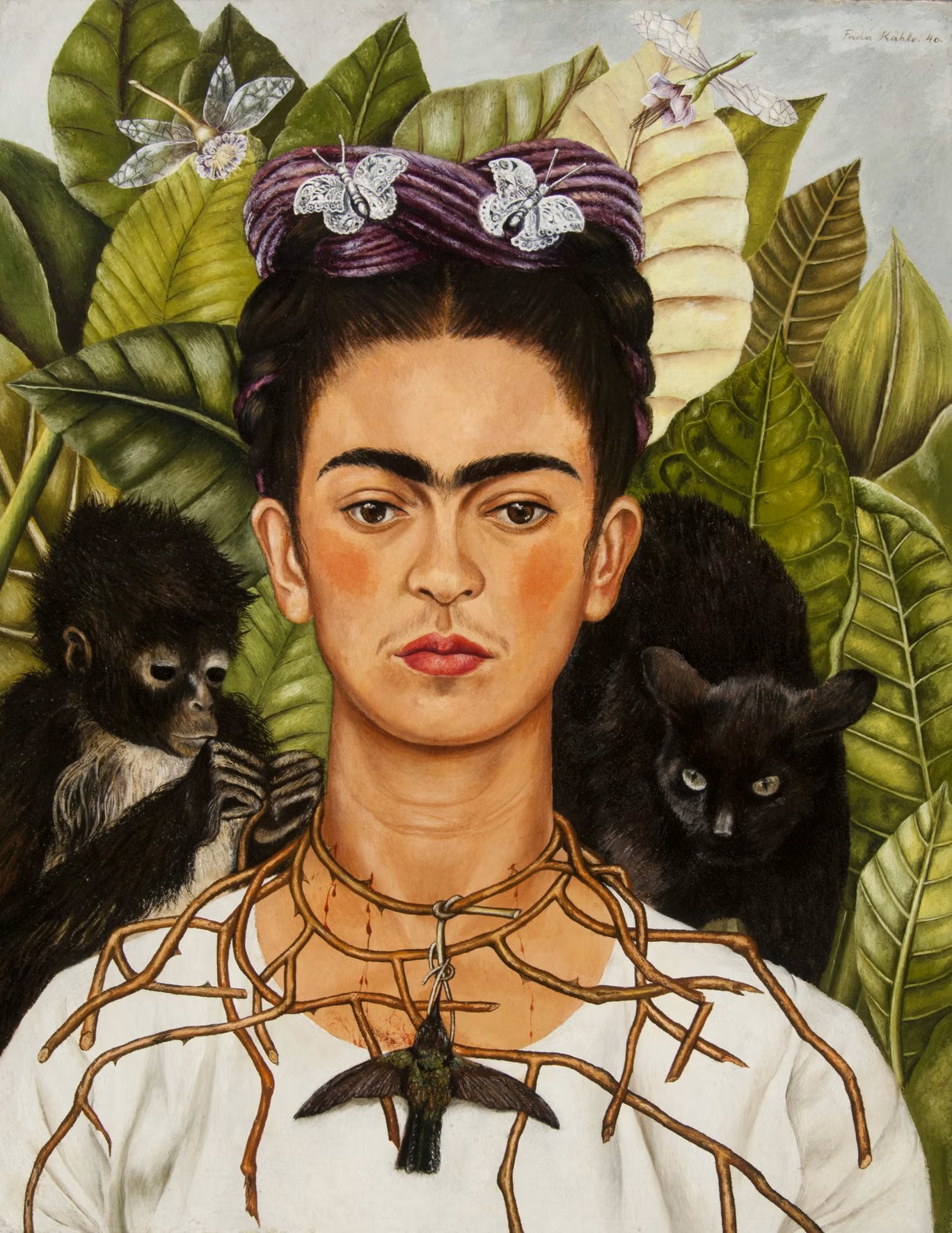
Frida Kahlo (Mexican, 1907–1954), Untitled [Self-portrait with thorn necklace and hummingbird], 1940. Oil on canvas mounted to board. Nickolas Muray Collection of Mexican Art, 66.6. Harry Ransom Center.
Fridamania: The Global Icon
The exhibition culminates in a vivid exploration of Fridamania the transformation of Kahlo into a global brand. More than 200 commercial objects trace the evolution of her image across decades: from political symbol to pop‑culture icon, from feminist emblem to commercial powerhouse. It is both celebration and critique, a reflection on how an artist who fiercely guarded her identity became one of the most reproduced faces in the world.
A Journey Into the Heart of a Legend
Frida: The Making of an Icon is not a retrospective. It is a cultural excavation a journey into the making, unmaking, and remaking of one of the most recognisable figures in art history. It asks not only who Frida Kahlo was, but who we have made her into, and why she continues to matter so profoundly.
Scarcity has not diminished her power.
It has sharpened it.
And London, once again, is ready to be captivated.